September 8, 2026 · 5 min read · GeniusCook Culinary Tech Team
AI Recipe Generator vs. Traditional Meal Planner: Which Is Right for You?
Choose an AI recipe platform when your constraints change daily — what is in the fridge, who is eating, how much time you have. Choose a static recipe site or a manual planner when you cook a stable rotation of dishes you already know and simply want them written down.
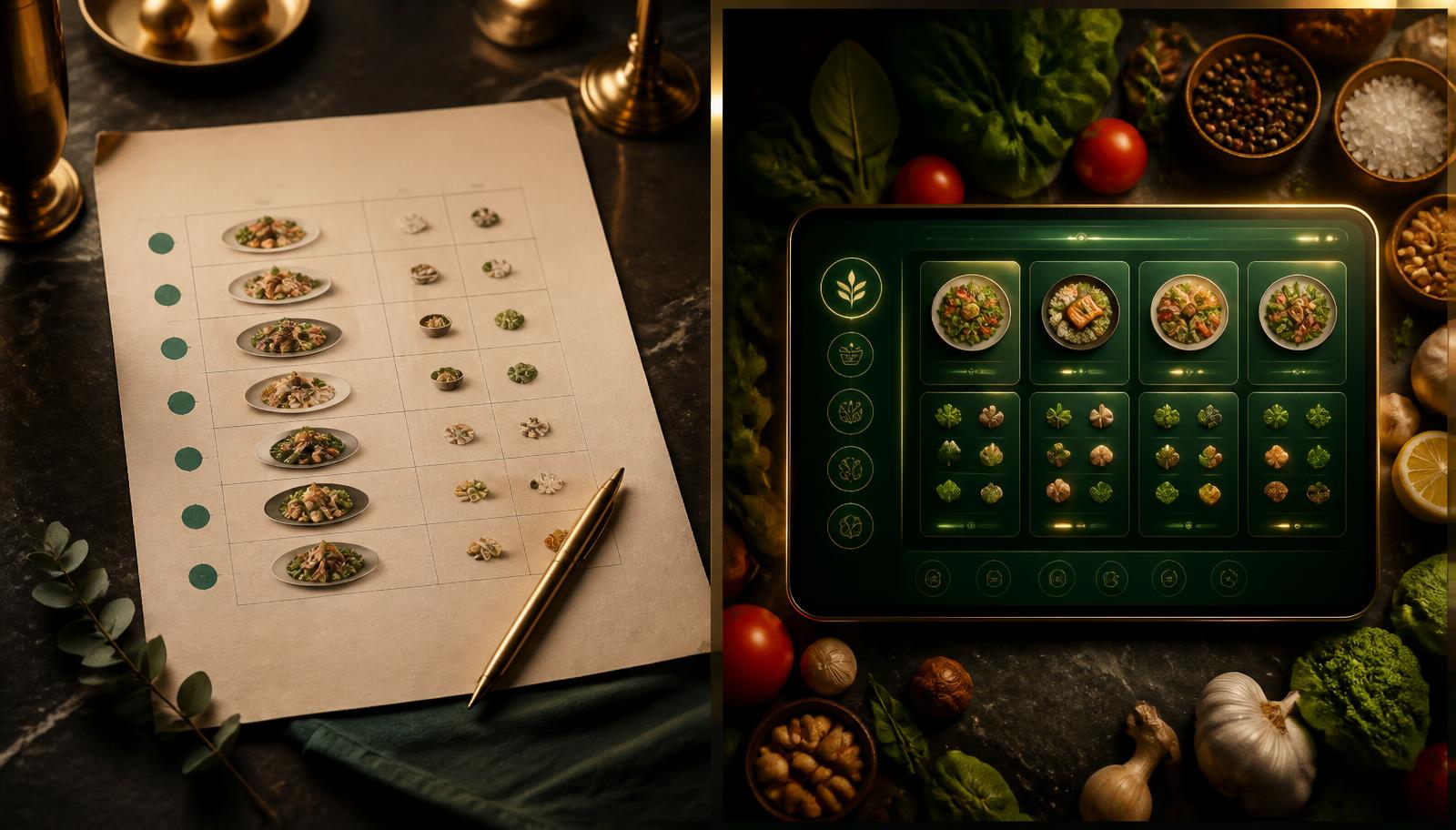
Feature comparison matrix
| Parameter | Static blog recipes | Manual meal-prep apps | GeniusCook AI |
|---|---|---|---|
| Real-time substitutions | None — swaps are prose suggestions at best | Manual: you edit the ingredient and the nutrition yourself | Automatic: a swap resolves to a comparable ingredient and macros update with it |
| Shopping list sync | Copy and paste into your notes app | Builds a list from dishes you selected by hand | Generated from the dish, minus what your pantry already holds |
| Live Cook Mode guidance | Scroll and lose your place with wet hands | Step lists, usually silent and untimed | Hands-free voice sous-chef, step timers and multilingual narration |
| Personalised macro tracking | Fixed numbers for one fixed serving | Logged after the fact, if you remember | Live per-portion macros that follow every scale and swap |
Edge case one: pantry-first cooking
Pantry-first cooking is the scenario static recipes handle worst. You start from what exists — half a fennel bulb, a tin of butter beans, the end of a jar of tahini — rather than from a dish you already chose.
- Static blogs: you search by dish name, which is the wrong direction of travel. Searching by three specific ingredients returns recipes that need five more.
- Manual planners: you can filter a library by ingredient, but the library is finite, so odd combinations return nothing.
- AI generation: the ingredients are the input. The dish is built around them, and anything genuinely missing is proposed as an optional extra rather than a blocker.
- Waste impact: pantry-first generation is the single biggest lever on household food waste, because the awkward half-ingredients get used before they turn.
Edge case two: single-serving and irregular households
Most published recipes assume four eaters. Cooking for one, for two with different dietary needs, or for a table that grows by three on Sunday is where fixed plans quietly fail.
- Awkward divisions: a third of an egg or a quarter tin of coconut milk needs a rewritten method, not just smaller numbers. Generated recipes rescale the method as well as the quantities.
- Split diets: one plant-based eater and one high-protein eater at the same table can share a base dish with two finishing paths, each with its own macros.
- Leftover intent: you can ask for a dish that deliberately makes one extra portion for tomorrow's lunch, and the shopping list reflects it.
- Time constraints: a twenty-minute weeknight version and a slow weekend version of the same idea come from the same ingredients.
Final verdict
A static recipe site is a cookbook. A manual planner is a spreadsheet. An AI generator is a cook who knows your fridge, your diet and your schedule — and recalculates when any of those change. If your week is predictable, the cheaper tools are enough. If it is not, generation wins on the days that actually go wrong.
Cook from what you already have
Type the ingredients in your fridge and get a complete recipe with macros, a shopping list and hands-free cook mode.
Try GeniusCook AI GeneratorGlobal Flavors, Clean Nutrition.
Explore the collection